
Introduction
This policy sets out how mhs homes group will protect the health, safety and wellbeing of all our employees, customers, contractors and any other persons affected by the activities it undertakes.
This policy tells you:
mhs homes’ leadership commitment to protecting health, safety and wellbeing
roles and responsibilities of all affected parties from group board level downwards
general arrangements for managing a variety or health, safety and wellbeing issues
Scope
This health and safety policy describes the management system in place to manage health and safety and occupational health and wellbeing.
This policy applies to mhs homes group activities including Heart of Medway, and covers the provision, management and maintenance of tenanted and leasehold properties and estates including supported accommodation. And management of new property development.
Who needs to know?
All staff working for mhs homes group, including all temporary, agency staff and volunteers.
Internal stakeholders affected by this policy have been identified as; staff working for mhs homes including temporary, agency staff, volunteers and Board members.
External stakeholders have been identified as:
customers, tenants and leaseholders in mhs homes group properties,
members of public and visitors that may be affected by our work activities,
property management companies, contractors and our supply chain
local councillors and MP's
regulators – Regulator of Social Housing (RSH), Health and Safety Executive, Charities Commission and Kent Fire and Rescue service.
Associated documents
In order to fulfil mhs homes’ legal responsibilities, additional policies and procedures provide guidance to staff on how we manage specific areas of risk.
All policies and procedures can be found on the intranet and are monitored through the Policies and procedure matrix.
All new policies and reviews must be accompanied by a minor change of major change document before being submitted for review
H&S safety documentation and templates such as risk assessments, safe systems of work, accidents and illness data are all managed through T100, all documents are version numbered and tracked for changes. Risk assessments are subject to final approval at Assistant Director/ Director level before being published.
This policy is linked to the Strategic Plan 2024-2027.
Health and Safety Policy Statement
mhs homes group is committed to protecting the health, safety and wellbeing of its employees, customers and other persons affected by its activities. To achieve this commitment mhs homes will:
Take overall responsibility and accountability for preventing work related injuries and ill health, as well as providing safe and healthy workplaces and activities.
Comply with all legal and regulatory requirements
Make sure that all staff, including contractors and volunteers, are given adequate information, instruction, training, supervision, guidance and advice to allow them to perform their duties competently and in accordance with job requirements and risk assessments.
Consult with staff on matters affecting their health, safety and wellbeing to promote partnership and participation at all levels of the business
Aim to have the highest standards by continuing to benchmark and make changes where needed
Support appointed health and safety representatives at Board level and across the business
Provide adequate resources to establish, implement, maintain and improve the health, safety and wellbeing management system
Prevent accident and injury by eliminating hazards and reducing health, safety and wellbeing risks
Promote continuous improvement through policy, strategy, action plans and other initiatives
Integrate health and safety requirements into business processes and decision making
Prevent harm to customers by having arrangements in place for working safely in and around their homes
Protect colleagues from reprisals when reporting incidents, hazards, risks and opportunities
Maintain our assets and customers’ homes in a safe condition through our asset management systems
Advise leaseholders of their responsibilities to make sure they keep their properties safe and to protect our homes and other customers
Leadership will:
Promote a positive health and safety culture through mhs homes
Implement this policy with staff by assessing all work activities and making sure that health, safety and welfare controls and procedures understood, agreed and followed
Monitor and review activities, making sure mhs homes complies with our moral and legal obligations to keep all affected people free from harm
All staff are expected to understand their responsibilities, accountabilities and authorities and take care to protect their own and other people’s health, safety and wellbeing.
This policy is reviewed every year; if the law changes or if the way we work significantly changes.
Roles and responsibilities
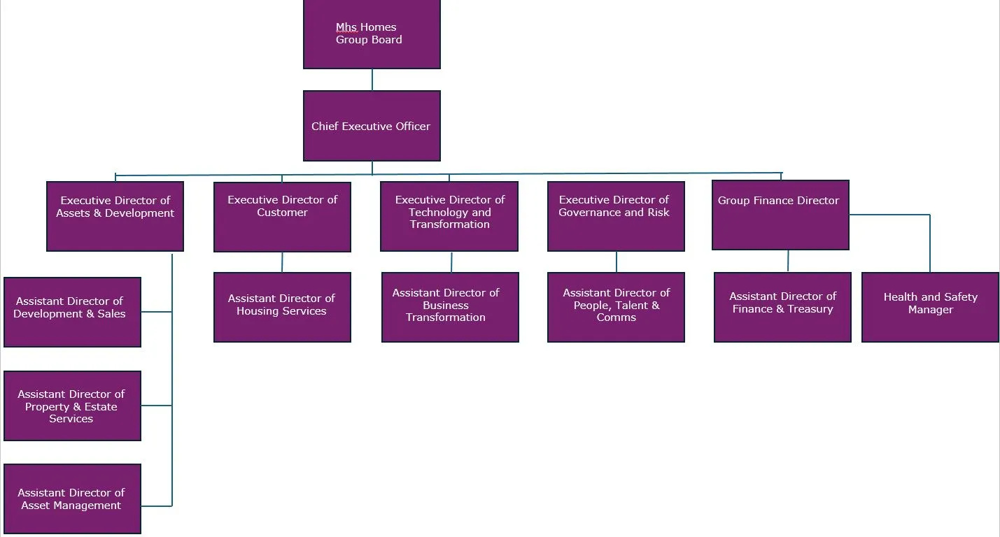
Strategic aims and objectives
mhs homes aims to have and support an open and engaged workforce, where H&S is visible and valued. We will strive for continuous improvement and ensure safety is at the heart of everything we do.
To achieve these objectives, we will ensure:
Engagement and participation at all levels - demonstrating that all staff have been able to give feedback, and that Leadership are visible to colleagues
Communication and transparency - giving managers and colleagues the information they need to be able to perform their roles safely
We are driving continual improvement and applying additional controls through lessons learned
We will aim to:
Ensure all inspection activities are completed digitally, removing the need for uncontrolled documentation.
Have zero RIDDOR reportable injuries and illnesses.
Ensure consultation is undertaken on risk assessments, safe systems of work and on upcoming changes.
Ensure 100% of risk assessments are reviewed, in date and approved by senior leaders before being communicated to colleagues.
Ensure health and safety be made a standing agenda for all team meetings.
We will measure this through:
Proactive monitoring of accidents and incidents
Monitoring of risk assessment registers through T100 and risk assessment sign off procedures to ensure compliance
The collation of evidence received from team meetings such as minutes and meeting agendas
The collation of data received from inspections, safety tours and shadowing activities
Targeted objectives this review period
Mhs Homes recognises that colleagues should go home from work in the same condition that they came to work, in order to help with this we will
Appoint a designated in-house safety trainer to deliver trainings to colleagues across the organisation to ensure a uniform delivery of essential information
Implement a program of clinical supervision/ Venting services for staff, to ensure the psychological wellbeing of front-line colleagues that may be exposed to traumatic experiences throughout the course of their work.
Implement the use of drones to conduct roof inspections and surveys, this will reduce the amount of working at height significantly
mhs homes Group Board
The Group Board (the Board) is collectively responsible for providing leadership and direction on mhs homes health, safety and wellbeing management system but isn’t involved in the day to day running of mhs homes.
The Board will approve the Health and Safety Policy and the Group Chair and Chief Executive will sign the policy statement.
The Board will take an active interest in investigations into significant safety failures.
All Board members will complete health and safety training to fully understand their responsibilities.
Board members will have a working knowledge of health and safety to assist in the discussion of health and safety. This will also help the Board assess whether the Chief Executive is managing health and safety adequately within mhs homes.
The Board will make sure health and safety is adequately managed and controlled based on the risk profile and to maintain compliance with the law.
The Board will:
Provide strong and active leadership, displaying visible commitment to achieving high health and safety standards
Integrate good health and safety management within business decisions
Engage with the workforce in the promotion and achievement of safe and healthy conditions
Monitor and review health and safety performance with the aim to drive continual improvement
Heart of Medway Board
The Heart of Medway Board (HOM Board) is responsible for the safety of the properties and customers in the HOM property portfolio.
HOM is subject to Safety and Quality Standard, requiring landlords to provide safe, good‑quality homes and services, and to maintain them effectively.
Chief Executive
The Chief Executive is responsible for implementing the Board’s vision for health, safety and wellbeing and communicating this vision to the whole organisation.
The Chief Executive will make sure:
Leadership principles are understood by all directors and followed to protect health and safety of everyone.
Business decisions are made with good consideration of health and safety and that adequate resources are made available
Management systems and arrangements are in place to effectively protect health, safety and wellbeing and to make sure that risks are controlled sensibly, responsibly and proportionally
A competent senior manager is nominated Health and Safety Champion to be responsible for executive control of implementing the health and safety management system. The nominated Health and Safety Champion is the Finance Director. They will ensure that health and considerations are made in business decisions.
Leadership team
The Leadership Team will display strong leadership principles, with visible leadership on health and safety including shop floor visits, challenging poor safety behaviours and praising good practice.
The Leadership Team will make sure that management plans are implemented and monitor policy arrangement through the organisation. Any issues arising from these arrangements will be investigated promptly.
Line managers
All managers, supervisors and team leaders are responsible for the health, safety and wellbeing of their staff.
They will:
Lead the planning and control of staff activities that may affect their health, safety or wellbeing
Give all new starters, agency workers and temporary workers a team specific induction including communicating risk assessments, emergency arrangements, lone working arrangements and other procedures relevant to their role
Communicate this policy to their staff and make sure that it’s followed
Risk assess work activities and control risks
Provide staff with information, instruction, training and supervision to enable them to have the competency to carry out their duties efficiently, effectively and safely
Make sure all equipment, plant, substances and personal protective equipment provided is fit for purpose.
Make reasonable adjustments to work to help staff to continue working safely. Reasonable adjustments might be required following sickness, an accident, any change in staff health or physical condition, after occupational health surveillance or referral.
Investigate accidents, incidents, near misses and dangerous occurrences and concerns raised.
Have the authority to update risk assessments and procedures to improve risk management.
Have the authority to stop unsafe work activities
All employees
All employees will:
Take care of their own health and safety and that of others who might be affected by their actions or omissions
Cooperate with all reasonable management requests by working to procedures, instruction and training received.
Report any shortcomings or failures in safety arrangements or equipment
Use equipment provided correctly and maintain it in good condition
Cooperate with investigations and provide adequate and accurate details
Not carry out a task that they aren’t authorised and trained or competent to do
Not intentionally or recklessly misuse anything supplied for health and safety
Have the authority to stop work that will put themselves or others in danger or at risk of harm.
VOICE representatives
VOICE Representatives will:
represent the interests and concerns of all staff and respond on their behalf. They provide insight, skills and resources for staff consultation
Workplace Health, Safety and Wellbeing Committee (WHSWC)
The WHSWC will be chaired by the mhs homes CEO. The Chair of VOICE will be in attendance to relay information between the two committees
Committee members will:
Raise concerns of fellow colleagues
Be consulted on significant changes to risk assessments and other changes that impact the safety of colleagues and those that come into contact with the business
Discuss and be given information on legislation changes
Conduct safety inspections of their respective areas
Work together to come up with effective solutions to safety and wellbeing related problems
Agree actions, action owners and timescales for completion
Human Resources
Human Resources will:
Monitor sickness absence data and advise on equality, diversity and inclusion issues.
Manage and monitor the occupational health and occupational surveillance service
Manage the staff appraisal and performance monitoring process.
Support managers by making sure they have access to training records
Manage and maintain all training records
Support staff with wellbeing issues and be responsible for implementing a wellbeing strategy
Competent advice and assistance
mhs homes has a Health and Safety manager to support and advise on health and safety issues.
The Health and Safety Manager will:
Formulate and develop health and safety policies
Plan for health and safety including the setting of objectives and deciding priorities
Advise on measures that need to be taken to comply with relevant legislation
Monitor health and safety performance across the business and share information throughout the business
Provide assurance to the Board that adequate health and safety management systems are in place.
All staff can speak to the Health and Safety manager for independent advice and to escalate worries and concerns.
We have an Occupational Health service, managed by the HR team for advice on health issues, health surveillance and recommendations to make sure that staff stay healthy and well at work.
Other expertise and consultants will be employed from time to time to help the organisation to deal with health and safety issues.
Communication
Suitable and relevant information relating to health, safety and wellbeing will be shared with staff.
This will start with health and safety in the induction for new starters.
Notices will be on display throughout the workplace and policies, procedures and guides will be available on the intranet.
Staff will be provided with instruction, information and training to help them carry out their work in a safe and healthy way.
There is information on our website specific to health and safety risks affecting customers and their homes.
Other health and safety management information will be shared with external interested parties on request.
Consultation and participation
Staff will be consulted on changes to health and safety risk management that will affect them. This will help staff to understand why procedures are changing and how it impacts the level of risk.
Issues not resolved by line managers should be reported up the chain of command.
If staff continue to have unresolved concerns these should be escalated to the Health and Safety Manager.
Where there are concerns of confidentiality, staff can make use of the separate Whistle Blowing Policy.
VOICE has representatives from around the organisation and feeds back on management systems. The committee can report concerns and recommendations it has to the Executive Team.
Health Surveillance
Health monitoring is provided where staff, through their work, are exposed to hazards affecting their health.
Staff identified through risk assessments will be provided with personal health surveillance by a specialist occupational health advisor.
Emergency procedures
Emergency procedures are in place including fire alarm systems within mhs homes main offices, blocks, schemes and foyers to give warning of imminent danger and all personnel to move to a place of safety.
Fire drills are conducted at least every 6 months at Broadside, Royal Eagle Close and Foyers with the alarm system being tested weekly.
Managers will make sure that staff and visitors are informed of and understand the appropriate procedures of what to do in an the event of an emergency evacuation.
Fire wardens are trained and appointed within our main offices, waste depot, schemes and foyer to assist with the evacuation process.
mhs homes has business continuity arrangements in place in the event of large-scale emergencies.
Training
Health and safety training is determined by a training needs analysis maintained by HR. HR manage and maintain all training records.
All training is evaluated to make sure that the content, quality and value for money is appropriate to the needs of the organisation.
Line managers are responsible for making sure their team have completed training and are competent to carry out their work.
Line managers must let HR know if staff complete any other training, evidence of contents and attendance (signed register), including tool box talks, video viewing and special briefings.
Management system
The health and safety management system is a cyclical process and is important to good health and safety management.
mhs homes management system is based on the HSE’s guidance HSG65 and ISO45001 that promotes a plan, do, check, act approach.
We plan our policy and how it can keep our colleagues and anyone affected by our works safe and healthy and we implement measures contained within the arrangements section of this policy in order to do this.
We constantly monitor the effectiveness of our management system by investigating accidents and incidents and identifying trends, or carrying out site inspections.
We use lessons learned to revisit and improve our plans, risk assessments and overall our management system.
Monitoring and improving performance
Compliance audits and inspections take place with all teams to identify areas for improvement and good practice.
Regular performance reports will be provided to the Board, HOM Board, Finance, Risk and Audit Committee and Leadership Team.
The reports will provide information on:
Accident and incident statistics
Legislation updates
Investigation outcomes
Audit outcomes
Policy changes
Training compliance
Interaction with regulatory authorities e.g. RSH, Charities Commission, Health and Safety Executive (HSE), Environmental Health, Fire and Rescue Services etc.
Improvements made to risk management
Annual review of opportunities for continual improvement
Risk management is reviewed by the Exectutive Director of Governance and Risk, and the operational risk map is reported to leadership team, FRAC, HOM and mhs group board.
Planned and ad-hoc audits are carried out to provide assurance on specific risk areas.
mhs homes will have its safety management system externally audited annually by the British Safety Council to give an additional level of assurance for the adequacy of our management system.
Arrangements
Accident reporting and investigation
Accident reporting applies to all people affected by our works including our staff, customers, members of the public and contractors.
All accidents and near misses must be:
Reported to your line manager as soon as possible
Recorded an Accident Form within T100 using a mobile device or desktop
Reported to the Health and Safety Manager to advise the investigator, monitor trends and escalate serious accidents
Appropriately investigated depending on the potential severity of the accident
All accidents, incidents and near misses will be investigated to identify areas of improvement. All recommendations are captured as actions within T100 and assigned action owners.
All completed accident reports will be held within T100 and linked to staff members file.
The Health and Safety Manager must report certain accidents and dangerous occurrences to the Health and Safety Executive (HSE) under Reporting Injuries, Diseases and Dangerous Occurrences Regulations 2013 (RIDDOR). Serious incidents and fatalities will be reported to the RSH and Charity Commission as appropriate.
Accident data and trends are reported to Leadership team, FRAC, HOM and mhs group Board for monitoring of health and safety performance.
Alcohol and drugs
If you’re taking medication, prescribed or non-prescribed, that could affect your safety at work you should tell your manager. This will be treated in strict confidence and will help you and your manager to assess any changes to your work that might be needed such as temporarily not driving for work.
Alcohol and drug misuse can create health and safety risks for yourself and other people around you such as your colleagues and customers. To make sure everyone is healthy and safe when at work we have the following rules.
Do:
Always check with your doctor or pharmacist about the side effects of your medication
Tell your manager if you think that your medication might affect your work
Tell your manager if you’re worried about someone else being under the influence of drugs or alcohol
Don't:
Leave your medication in your workspace unattended
Come to work under the influence of alcohol or drugs
Drink alcohol during working hours without prior approval of management
mhs homes will support staff that seek help by:
Reasonably adjusting work where possible
Having a confidential and independent Employee Assistance phone line
Providing details to local heath support services
Providing an Occupational Health service
If you’re under the influence of drugs or alcohol during work, then arrangements will be made to get you home safely. You may also be disciplined.
Staff found to be dealing drugs at work will be disciplined and reported to the police.
Asbestos
mhs homes has a separate Asbestos Policy and Asbestos Management Plan detailing our arrangements for working with asbestos and protecting our staff, contractors and customers from harmful asbestos fibres.
mhs homes has arrangements in place for managing up to date asbestos registers for all its assets.
Staff are not permitted to work on potential asbestos containing materials and must review the asbestos register before doing any intrusive works.
Any unplanned exposure to asbestos fibres must be reported to the Health and Safety Manager to be investigated and reported to the HSE where necessary.
Confined spaces
A confined space is any space of an enclosed nature where there is a risk of death or serious injury from hazardous substances or dangerous conditions (e.g. lack of oxygen or loss of consciousness due to an increase in body temperature).
All work in a defined confined working space must be avoided where possible. Where this isn’t possible the risks of the particular confined space must be assessed, and work planned to control those risks.
There will need to be emergency arrangements for working in confined spaces outlining:
How will you know if the person working in the confined space is okay and haven’t lost consciousness?
How will you get them out of the space if they do lose consciousness (it is not enough to rely on emergency services)? Only trained competent staff are permitted to work in confined spaces.
Only trained competent staff are permitted to work in confined spaces.
Breaking ground
Mhs homes recognises that excavations pose a significant risk of coming into contact and damaging hidden services. All work involving breaking ground will be properly planned, with an operational digging checklist being completed before work commences to ensure all precautions are in place including:
Risk assessments and Safe systems of work being present with a confirmation of the operatives understanding of safe digging practice.
Service maps have been obtained before work starts.
All relevant equipment is onsite including insulated tools and service detection equipment.
Training has been undertaken on the use of service detection equipment.
Ground surveyance has been undertaken prior to work commencing.
Where services have been detected in the immediate area to where work is being carried out, the service provider will be contacted to arrange for them to be isolated and supervised before work is carried out.
Control of contractors
All contractors, consultants and suppliers carrying out work on behalf of mhs homes group are required to be assessed as competent and to have the resources to carry out the work safely. For each project or contract there will be a named contract manager.
Contract managers will:
Make sure that the contractor is suitably competent to carry out the work safely
provide contractors with details of hazards and risks that may affect the contractor when they do work for us
Obtain and reviews RAMs from contractors prior to work being completed
continue to monitor health and safety throughout the duration of the contract through contract meetings and key performance indicators
evaluate health and safety of the contractor at the end of the contract
For all construction works, mhs homes will fulfil requirements under the Construction (Design and Management) Regulations 2015 to make sure all work is done safely and healthily. Where needed, mhs homes will appoint duty holders under CDM to complete works.
The Procurement Regulations on The Intranet require that all contractors are fully assessed, and that health and safety is evaluated within the procurement process.
Customer safety
Our properties are maintained in a safe condition and all statutory health and safety servicing is carried out.
All colleagues and contractors working in customers’ homes will be assessed and where appropriate go through a Disclosure and Barring Service (DBS) check.
Where risks are identified with customers’ homes, mhs homes will attempt to work with other local services to reduce risk as far as possible.
Construction work being done in and around customers’ homes will be planned to make sure it’s done safely, and the work area is secure to prevent harm to customers and members of the public.
By signing their tenancy agreements, customers agree to take on the responsibility of reporting defects for repair.
Display Screen Equipment (DSE)
Staff that use DSE such as PCs, laptops, tablets and smartphones daily, for more than an hour at a time as part of their work are DSE users. Our DSE users are working in the following ways:
At fixed workstations and hot-desking
Mobile working
Home working
All DSE users are required to complete a workstation self-assessment on the e-learning portal. Mhs homes will supply the equipment needed to ensure that all workstation set ups are adequate e.g. mice, keyboards, laptop stands, document holders etc.
Staff are encouraged to be agile in the office and don’t need to do a workstation assessment every time they move. Staff should adjust each workstation to suit their needs and take additional ergonomic workstation equipment they’ve been given to other workstations with them.
Staff with more complex health issues affecting their DSE use will have a further face to face assessment with the Health and Safety Team and where needed a referral to the Occupational Health service.
Eyesight testing for DSE users is paid for by mhs homes by HR. If glasses are needed specifically for DSE use a contribution will be made by mhs homes to cover the standard lens and frame only.
Incorrect use of DSE and poorly set up workstations or work environments can lead to pain in necks, shoulders, backs, arms, wrists and hands as well as fatigue and eyestrain.
Tips for staying healthy using DSE:
20:20:20 rule - Every 20 minutes, look away from your screen for 20 seconds at something at least 20 feet away Use a separate mouse and keyboard if you’re working from a laptop regularly
Change positions, get up and move around regularly
Use a good supportive chair; don’t be tempted to set up on the sofa for the day
Electricity at work
mhs homes has a separate Electrical Safety Policy and Procedures detailing how electrical circuits, equipment and appliances are maintained.
Only skilled, competent operatives and contractors are to work on electrical issues. The Principal Duty Holder maintains a ‘competent persons’ register and makes sure that the standard and quality of electrical work is maintained.
Work on live circuits is not permitted under any circumstances. Steps must always be taken to make safe and lock-off or isolate circuits before work starts.
Employees must report faults on electrical equipment immediately. Staff must not use or continue to use faulty equipment. Staff must not carry out electrical repairs unless authorised to do so.
Fire and evacuation
mhs homes has separate Fire Safety Policy and Procedures detailing how fire safety is managed in corporate properties and our asset portfolio.
All non-domestic areas (corporate offices, communal corridors and stairwells) have regular fire risk assessments (FRA). And there are processes and programmes of work in place to manage any actions that come out of the FRAs.
All mhs homes properties (corporate, commercial and domestic) have fire plans in place based on risk. The fire plans for each property are communicated to the building users through signage and training for staffed premises.
Legionella management
Mhs homes has a separate water systems safety policy and procedure detailing how water systems are assessed and managed to prevent the risks of legionella and associated bacteria.
All water systems where required by ACOP L8 will be risk assessed at a maximum of a 2 year interval by a specialist external consultant.
Any building or system having substantial change to the water system will have a new risk assessment carried out prior to reuse of the water system.
Gas safety
Mhs homes has a separate gas safety policy and procedure detailing how all of it’s domestic, commercial and communal gas appliances are serviced and maintained.
mhs homes undertakes gas safety checks of all its domestic and communal gas appliances on an annual basis.
In addition, mhs homes will carry out a gas appliances service in conjunction with the gas safety checks and complete all necessary repairs and replacements promptly.
Mhs homes will appoint/instruct a suitably qualified contractor to deliver a service level contract for commercial heating plant, including servicing and repairs. This will also include the provision of periodic gas safety inspections and records.
Lifts
Mhs homes will carry out statutory servicing and maintenance of lifting and lowering equipment to fulfil our duties under the Lifting Operations and Lowering Equipment regulations. To do this we will.
Appoint a competent contractor to complete servicing and inspections
Isolate all lifting equipment where equipment is deemed not safe and compliant until remedial work has been completed
Conduct regular audits of lift inspection and maintenance contractors
Carry out relevant lift upgrades to comply with all current safety standards
Mhs homes has a separate Lift Safety Policy that gives further details of how lifting equipment is managed
Building Safety
mhs homes has a separate Building Safety Policy that applies to higher-risk buildings as defined within Part 4 of the Building Safety Act, this applies to buildings with at least seven storeys or that are at least 18 metres in height with at least two residential units.
First aid
First aid requirements are determined through risk assessment. There will be sufficient numbers of trained first aiders, equipment and facilities to deal with minor accidents and emergencies at work. Names of nominated first aiders are on display throughout the workplace.
First aiders are available to help injured and ill staff in an emergency. Although our first aid provision is for staff, there may be instances where customers in our properties may seek assistance. Staff can and should help these customers.
First aid arrangements in Broadside and Royal Eagle are managed by the Facilities Team. In our offices, first aid boxes are located around the workplace and are checked monthly by nominated first aiders. These first aiders contact details are displayed around the workplace. At remote locations and for mobile staff, first aid arrangements are managed by service areas managers as per their team and site-specific risk assessment.
First aid kits are checked regularly, according to risk assessment, by responsible persons within each service area and records maintained.
An automated external defibrillator (AED) is available in Reception at Broadside and the office at Royal Eagle. Nominated first aiders are trained to use the AED.
Mobile staff are to carry a first aid kit in their vehicle at all times, regularly check and replenish as needed, and will compete emergency first aid training to help them to self-treat minor injuries.
Hazard reporting
All staff must report hazards and defects, not only because of a legal duty but to fulfil a moral duty to protect fellow colleagues.
Each hazard found needs to have an action and follow-up to make sure it is dealt with. Staff that find hazards must take ownership of making sure that no one will be harmed, either by immediately fixing or preventing access, and reporting to their line manager and relevant teams for actioning e.g. hazards in the office would be reported to the Facilities Team. Hazards that have caused accidents, injuries, near-misses and damage must be reported to the Health and Safety Team.
The staff member finding the hazard should take a picture of the hazardous situation or circumstances, without putting themselves at risk. This will help understanding of the risk, deciding works required and could avoid a revisit.
Hazards are to be reported through the T100 software.
Hazardous substances
Managers will make sure that exposure to hazardous substances is minimised. Risk assessments must be done for all work activities involving exposure to hazardous substances; these are called COSHH (Control of Substances Hazardous to Health) assessments. If staff are unsure about substances that they are going to use, they must ask for safety information or advice from their manager.
Managers will give staff information on the substances they are required to use, how to use them safely and risk associated with them.
Staff will be provided with personal protective equipment (PPE) to use as directed by COSHH assessments.
Asbestos is dealt with separately within the Asbestos Management Plan.
Health and wellbeing
Healthy teams are more likely to feel in the right frame of mind to give great service to our customers.
An mhs homes health and wellbeing programme is in place to promote and improve staff health and wellbeing. Managers will promote healthy behaviours, encourage healthy conversations and support staff to work in a healthy way.
There is an Employee Assistance Programme (EAP) is available to all staff. It is a free personal helpline provided by Health Assured. Staff and their family can use it for professional confidential advice or support. The contact number is 0800 030 5182.
The value placed in the wellbeing of our colleagues can be seen by the successful accreditation of the silver award for “We invest in Wellbeing” from Investors in People, the next full assessment is scheduled for 2027 where we aim to reach Gold accreditation. mhs homes is also currently accredited to Gold level for investors in people, we will aim to retain this level of accreditation in the coming years.
Induction training
All staff (permanent and temporary) will receive health and safety information as part of the induction process. The training will include an overview of mhs homes’ leadership and commitment to health and safety, individual responsibilities and contents of the Health and Safety Policy.
Line managers will make sure that new staff understand the team specific risk assessment and any other safety specific guidance applicable to their role. Staff doing safety critical roles, such as multi-traders, will require direct supervision and assessed as competent to carry out work alone.
Induction forms for agency staff and work experience placements are held by HR. These must be completed by the relevant line manager and returned to HR, before any actual work takes place.
Lone working
Lone workers are staff that work by themselves without close or direct supervision. Staff whose job involves lone working must be informed of the hazards, understand the risks and use the systems and procedures for safely working alone.
There is a specific Lone Working and Personal Safety Policy and staff guide for colleagues required to lone work. Line managers must assess the lone working risks to their team and put in place controls and processes to make sure staff are kept safe.
Manual handling
Manual handling should always be minimised so far as is reasonably practicable. All manual handling tasks will be risk assessed. Where heavy materials are used, managers should investigate if different lighter materials are available to use. Lifting aids (e.g. trolley or barrow) should always be used where required. Staff required to carry out manual handling as part of their role will receive training on safe manual handling techniques. All injuries caused by manual handling must be reported to make sure that trends are being captured and control gaps are identified.
New and expectant mothers
mhs homes will take all reasonable steps to safeguard the health, safety and welfare of new or expectant mothers and their unborn child. When a staff member tells their manager that they are pregnant, HR will be informed. Managers will carry out special risk assessments with people that are pregnant, have given birth within the last 6 months or are breastfeeding to make sure that risk is minimised. Any significant change in the work carried out by the new or expectant mother or their health condition will need a review of the risk assessment.
Noise at work
Regular uncontrolled exposure to excessive noise can result in noise induced hearing loss.
mhs homes will risk assess work related noise and reduce exposure as far as practicable. Exposure to noise will be controlled at source through procurement and maintenance of equipment. Hearing protection is only a last resort to prevent exposure to noise.
Periodic hearing tests will be provided for staff exposed to identified sources of excessive noise.
Occupational health and Health surveillance
We have a monthly occupational health service available for all staff. It provides guidance and support to staff and managers to help staff working well by considering the effects of health on work and work on health.
Staff can be referred into occupational health by managers, auto referred for surveillance, following return to work from ill health or self-referred.
Health surveillance is arranged for all staff that are exposed to health risks through their work.
Office safety
To help make sure that workplaces are kept safe, we follow these basic rules of good housekeeping:
Correct use of waste bins and bins emptied regularly
Removal of large combustible materials
Floors cleaned regularly
Walkways and escape routes kept clear of obstacles
Trailing cables stored safely
Broken office furniture must be reported to the Facilities Team immediately.
Permit to work
High risk work may need tighter controls which can be covered by a permit to work (PTW) system.
Permits to work are a written management plan of a high-risk activity. The work is only permitted for a specified time period and will include additional controls above any team specific and generic risk assessment. Permits to work will be issued through the T100 Software system.
Personal Protective Equipment (PPE)
Appropriate PPE will be determined by risk assessment. It will be used as a last resort when the risks can’t be adequately removed or controlled by other means.
Staff will be trained and competent in how and when to use their PPE, how to look after it and why it is needed.
Staff must:
wear PPE as instructed by management
use it in accordance with manufacturers instruction, plus any specific training provided
make sure protective clothing fits correctly and is adjusted
store, clean, repair and maintain their PPE
report defective PPE for replacement
Staff must not:
buy or acquire their own PPE without approval from their manager
PPE will be provided at no cost to the employee. Suspected negligence of PPE will be investigated by line management.
Line management will check use of PPE during site visits and enforce its use.
Risk assessment
All tasks are risk assessed. Risk assessment will identify hazards and evaluate the risks to both staff and any other person who may be affected by these activities.
Risk should be reduced to the lowest reasonably practicable level by putting in controls, in order of priority. Risk assessments will also consider opportunities, benefits and potential to improve occupational health and safety performance.
All risk assessments will consider the following categories of hazards:
Physical – unsafe working conditions
Psychosocial – hazards that have an impact on mental health or wellbeing
Chemical – hazardous substances that can cause harm
Biological – viruses, bacteria, insects, animals etc.
Ergonomic – physical factors that result in musculoskeletal injuries
mhs homes will control risks by working through the risk hierarchy:
1. ELIMINATE– redesign the job or change a substance so the hazard is removed
2. REPLACE – Replace the process or the substance with a less hazardous one
3. ENGINEERING CONTROLS – Use work equipment or other measures to reduce the risk. E.g. guarding or ventilation systems. Give priority to measures which protect the group over individual measures.
4. ADMIN CONTROLS – Identifying and implementing controls to work safely. E.g. Banning mobile phones in hazardous areas, reducing the time workers are exposed to hazards by job rotation etc. Information, instruction and training.
5. PPE – Only after all the above controls have been tried should PPE be used to control residual risk
Health and safety risks are rated by the below 5x5 matrix:
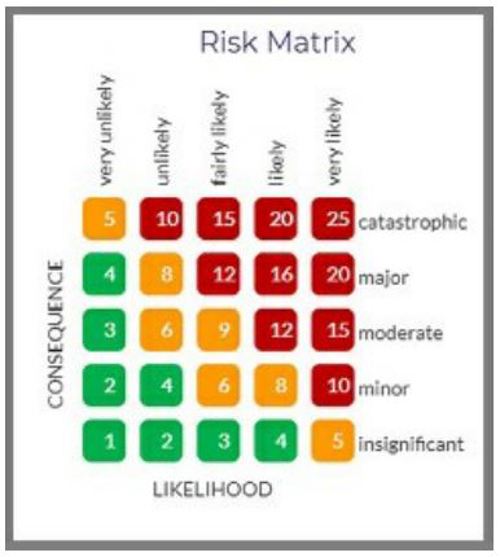
Control measures should be clear and easily understood by all staff who are required to use them. Written procedures, including Safe Systems of Work should be prepared for more complex work.
Risk assessments are recorded with T100. Completed risk assessments must be communicated to staff carrying out the work and a record of this communication kept.
Managers with the teams carrying out the work will review their team risk assessment at least annually, or following significant changes in the way they work, accidents or legal/best practice changes. It is essential that consultation within teams takes place to ensure all risks have been realised.
mhs has a separate risk assessment procedure for mangers to follow, the procedure highlights the approval route for all assessments.
Safe Systems of Work (SSoW)
A SSoW will be created for all processes that pose a significant risk to colleagues, this will be identified through risk assessment.
The safe system of work will give detail on how higher risk work is planned and safely implemented and will be linked to relevant risk assessments, COSHH assessments, Manual handling assessments and PUWER assessments. These will be created within T100.
Safety team inspections
Workplace inspections help to monitor the effectiveness of control measures and safe systems of work. Management must schedule regular inspections of their service areas and their staff.
Poor practice noted in inspections must be acted upon and learning shared with appropriate team. A clear record and audit trail must be kept for these inspections and available to relevant managers. Actions coming from inspections will be recorded through T100 and assigned to relevant action owners.
The H&S team will conduct regular inspections to make sure safety protocols are being adhered to, findings will be fed back to the relevant department manager.
Leadership Team Inspections
The mhs homes leadership team recognises the importance of leading from the front, fostering an open door policy when it comes to safety, colleagues can openly raise concerns to top management without the fear of reprimand.
Leadership team members will complete one inspection per quarter each which equates to approximately 2 inspections per month. This enables colleagues to be able to raise concerns directly with top level management and gives further oversight and assurance that staff are working in a safe and healthy way.
Compliance assessments
Compliance assessments will be routinely completed by the H&S team to ensure mhs homes are fulfilling their legal obligations and that correct controls are in place.
Compliance assessments will be completed following the ISO45001 standard with actions being communicated to relevant teams and leadership.
Internal audit training will be provided to H&S team members required to undertake compliance assessments.
Sharps and needles
Our frontline staff, working in the community and in customers’ homes, are at risk of contact with sharps and needles. Contact with needles and sharps can potentially result in exposure to blood borne viruses such as hepatitis and HIV.
Staff at risk will have risk assessments to control the risk and are trained to help them to identify areas where needles may be hidden, to prevent contact and what to do following a needle stick injury.
If found, staff are not to pick up sharps or needles unless they have been trained to do so and have the correct equipment for disposal. For staff not trained to collect sharps, they must report the finding to management and the sharps can be collected by the Caretaking team.
If staff are injured or come into contact with bodily fluid, they must follow the steps on the Staff Guide for Prevention of Injury from Sharps.
Smoking and vaping
mhs homes has a strict ‘no smoking policy’ in all offices, work sites and vehicles. The appropriate signage will be on display in these locations and areas as required by law.
There is no time allowance for smoking and vaping breaks during normal working hours, these breaks should be taken in their normal rest breaks.
Some staff use e-cigarettes which fall outside of smoke-free legislation. mhs homes does not allow vaping in the workplace. Although they don’t make smoke, e-cigarettes do produce a vapour cloud that could be a health risk or annoyance to other employees in the same space.
Staff working in customers’ homes may be exposed to passive smoking. Staff will make residents aware that they should not be smoking during these visits. If customers refuse to stop smoking, staff can politely refuse to continue the meeting and inform management of the situation.
Stress
Managing work related and organisational stress needs a corporate approach to prevention and treatment.
mhs homes will identify all work-related stress factors and reduce these as far as is reasonably practicable. This is based around the HSE management standards with six primary causes for stress at work:
Demands – Includes issues such as workload, work patterns and work environment
Control – How much say to people have over the way they work?
Support – Includes encouragement, sponsorship and resources provided by the organisation, line management and colleagues
Relationships – Includes promoting positive working to avoid conflict and dealing with unacceptable behaviour
Role – Do people understand their role within the organisation and does the organisation make sure that roles aren’t conflicting?
Change – How is organisational change (large and small) managed and communicated?
Managers must support staff that are suffering with stress by making sure:
staff are fully trained to do their work
staff have meaningful development opportunities
workloads and hours are monitored to make sure staff are not overloaded or underutilised and that full holiday entitlement is taken
work-related contact outside normal working hours or whilst on holiday is discouraged
bullying and harassment is not tolerated
reasonable adjustments are made where possible for staff feeling stressed
signposting to the EAP and;
seeking additional advice from HR and/or Occupational Health if needed.
mhs homes aims to have a working environment where all employees have the confidence to ask for help and problems are solved.
We have an Employee Assistance Programme (EAP). This provides free, professional, specialist and confidential advice and support on areas that can commonly cause stress and anxiety in people’s lives.
Vehicles and driving
Driving is one of the most hazardous activities that mhs’ staff do. All drivers (fleet and grey fleet) must:
Read and understand the Driving Safety Policy
Sign the drivers declaration
Provide HR with insurance certificates, MOT certificates and license documents.
Notify HR of any driving penalties or convictions
HR do regular driver checks to make sure that staff have got a license and they are legal to drive. Fleet vehicles are fitted with trackers to monitor driver behaviours, identify training needs and to locate company vehicles.
All staff are reminded that using a mobile phone whilst driving is against the law. Anyone caught breaking the law will be disciplined.
Vibration at work
Regular uncontrolled exposure to vibration can result in irreversible, painful damage to your hands, fingers and back. Staff are exposed vibration by working with large power tools (e.g. hedge trimmers, chainsaws, breakers etc.) and ride on machinery (e.g. mowers, tractors, etc.).
Managers must monitor tool usage and maintenance to make sure that staff are not exposed to excessive vibration. Managers must make sure that:
Exposure to vibration never exceeds the exposure limit value of 5m/s2 A(8)
Controls are reviewed where staff are regularly exposure to daily vibration of more than 2.5m/s2
Exposure is as low as reasonably practicable
Managers will control vibration exposure by:
Carrying out risk assessments on all staff work activities to minimise exposure to their staff
Referring regular vibrating tool users for health surveillance
Buying tools and machinery that have the lowest vibration value and offer value for money
Actively monitoring tool usage for staff showing symptoms of hand arm vibration syndrome
Managing regular maintenance and servicing of equipment to maintain low vibration
Training and informing tool users of the risks and controls when using vibrating tools
Review work patterns to rotate use of high vibrating tools
Give staff working outside thermal gloves to wear whilst operating tools
Testing machinery to make sure that vibration values are accurate.
Violence at work
For staff incidents please see the Bullying and Harassment Policy on The Intranet. Violence and aggression at work is not tolerated. mhs homes will take all reasonable action to protect and support staff who are threatened, abused or physically assaulted in the course of their work.
Managers must make sure that procedures are in place to protect their staff safety. This might include closer supervision or working with a colleague or as a team. Customers that may pose a threat to our staff are noted on Open Housing. Staff entering customers’ homes must check this information before any appointment so that specific arrangements can be made.
All instances of violence at work, including verbal abuse and threats, must be reported via the violence and aggression app (V&A) or desktop module. These send notifications to line managers to investigate. The Health and Safety Manager and Customer Team Manager review the incidents to make sure that lessons are learnt, and the appropriate outcomes were reached.
There is more information in the Lone Working and Personal Safety Policy and our Managing Unreasonable Customer Behaviour Policy on the intranet.
Visitors
Before coming to our premises, staff need to check any special arrangements that may be needed by their visitors. If a visitor has a disability that may affect their safe evacuation, then the staff escort must contact the Facilities Team or on site management for a Personal Emergency Evacuation Plan (PEEP) to be completed.
Visitors must:
sign in to site
wear a visitor ID badge
be met by a responsible person
sign out when they leave – this is to help in fire evacuations/emergencies
Meetings with customers must not be arranged out of office open hours, 8:30am – 5pm, as there may not be enough staff to assist in an emergency situation.
Children must be supervised at all times.
Work at height
Where practicable, work at height must be avoided. Work at height activities must be risk assessed to identify the best method and most appropriate equipment to be used to safely work at height.
Most work at height will be standard activities that will be covered in team risk assessments. More complex tasks will require a site-specific risk assessment and method statement to carry out the work safely. Care must be taken when working on or around fragile surfaces (roofing and sky lights) where fall risks may not be immediately obvious.
Work areas must be segregated from other workers and members of public where there is a risk of others being injured below.
Only staff that are trained and competent can work at height and can only work on permitted access equipment. Staff must only use access equipment where there is evidence the equipment has been checked as safe (a scaff-tag in place with a valid date) and they have done a visual inspection.
Work at height includes working around excavations where there is a potential for falls. These instances will be risk assessed on site and safe access and segregation arranged.
Work equipment
Each team must have a full register of work equipment that is permitted for use on their site – this includes staff’s own equipment. The register should include schedule of checks, inspections and maintenance for all plant and equipment. Management must review the safety aspects of new equipment before buying to make sure that there is a reasonable balance between safety and cost.
Mobile plant and equipment must be suitable for the intended use. Ride-on machinery safety checks must be carried out before each use. Any built-in safety features such as rollover protection structures (ROPS) and seal belt must remain in place.
Power tools should ideally be 100V or battery powered for all construction work, reducing the likelihood and intensity of electric shocks. If 230/240v tools are used a residual current device (RCD) must be used. 230/240v equipment must not be used in wet areas or in wet weather.
All tools used in construction and grounds teams must be of industrial quality, not domestic, with visual user checks and periodic testing to maintain safety.
Staff can get management permission to use their own tools and equipment whilst carrying out mhs homes work. These must be included as part of the inspection regime and receive the same maintenance as tools owned by mhs homes.
Young people
Young people and children at work are at a higher risk at work because of their lack of experience and physical maturity. At work they need additional supervision and instruction.
Young people are defined as people under the age of 18. They need a risk assessment for the work they’ll be carrying out. The supervisor of the young person must review the risk assessment to make sure it is suitable and sufficient for the individual.
Children are those up to 16 years old. They must be directly supervised at all times. Parents and guardians of children will be advised by HR of the personal risk assessment and controls to be taken to protect the health and safety of their child whilst in our care.
All work experience people and children will have a health and safety briefing, a copy of the young people risk assessment, with specific controls added if needed, prior to starting work. The names of the relevant manager and staff member supervising the young person will also appear on the risk assessment.
Principles
Equality statement
mhs homes has a duty to ensure that no person receives less favourable treatment from the organisation on the grounds of age, disability, gender reassignment, marriage, civil partnership, pregnancy, religion or belief, race, sex or sexual orientation.
Data protection
mhs homes will only share information that meets the requirements of the Data Protection Act 2018 and the UK GDPR. Confidentiality and impartiality will be exercised by mhs homes at all times.
Feedback
We welcome suggestions and comments from people who use or provide our services. We believe that this can provide some important lessons to help us ensure that the service is improved for everyone.
If you have something to say about this policy or the information that is provided, then please let us know. Please refer any comments to the author of this document.